From the lux nova of Gothic architecture to the spatial light installations of Moholy-Nagy, Turrell, and Eliasson, there has been a long history of attempts to understand light not as a fixed object, but as a phenomenon that acts on the world and our senses and always arises in response to its surroundings.
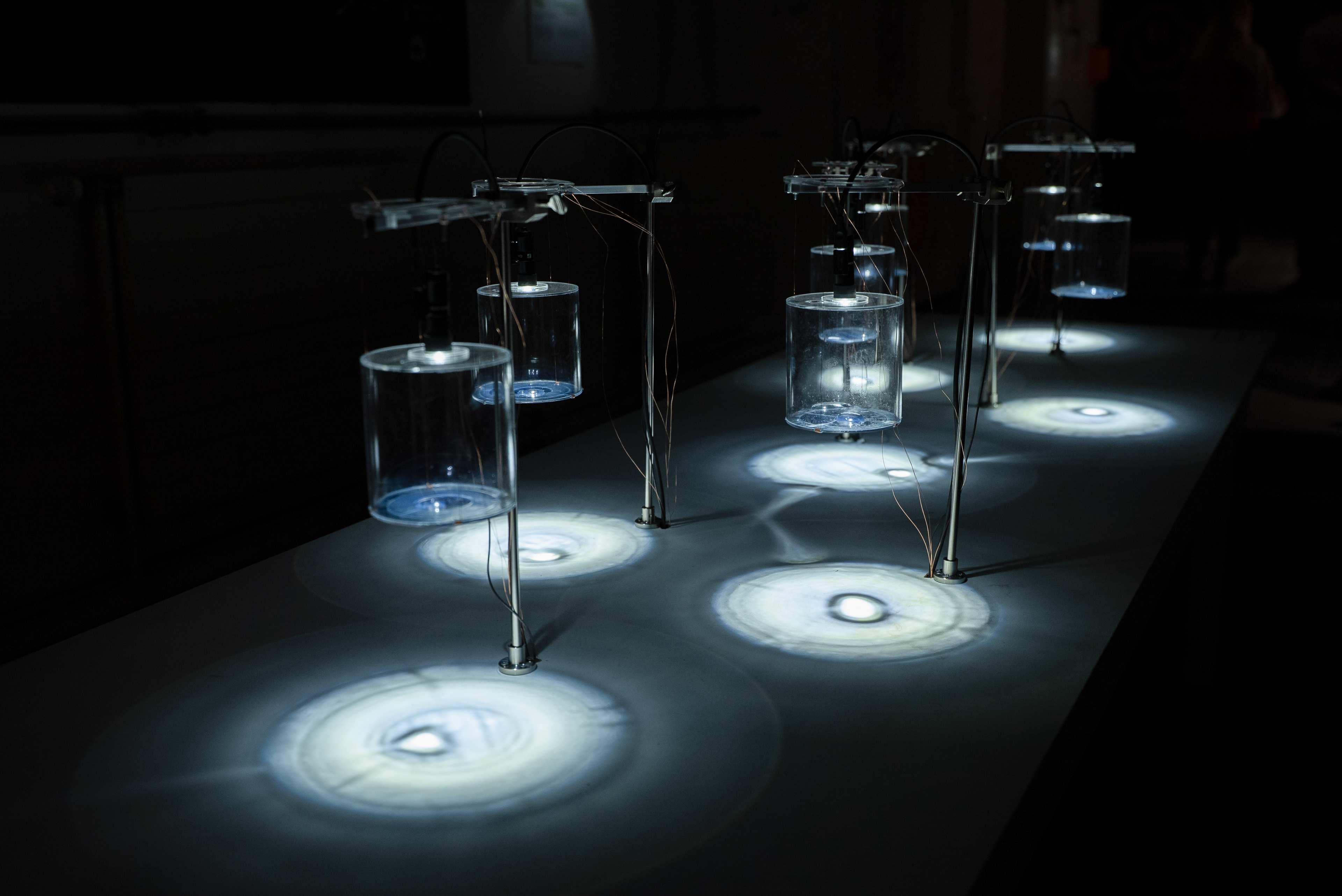
Living Lens carries this lineage forward. Using the soft, unstable material of a water droplet, it condenses the phenomenon of light to a tabletop scale and reconstructs it, bringing forth the generation and transformation of light. The droplet, acting as a "lens," moves silently along a transparent trajectory that is electrically controlled through the principle of electrowetting. As light from the source passes through the droplet-lens, it takes on the softness and wavering inherent to water, and the droplet's nonlinear movement emerges in the space as a gradual shift in the image of light.
Mai Ohira, Takafumi Morita (電装設計), Yasuaki Kakehi (指導教官).